The term “deposit return” is made up of two distinct but inseparable parts: the deposit value that engages the consumer, and the actual return of beverage containers for recycling. High-performing deposit return systems make the return of empty drink containers easy for the consumer, by making it as easy as it was to purchase the beverage in the first place.
“Return to retail” refers to the aspect of deposit systems where retailers who sell beverages must take the empty containers back for recycling. Nine out of 10 of the world’s best-performing deposit return systems employ some form of return-to-retail collection, achieving an average return rate of 92%.Retailers have been involved in container returns since at least the early 1900s when the original systems for reusable containers were common. As one report on the history of packaging put it, “if an apothecary or merchant provided goods in a bottle, there was typically an understanding that the bottle belonged to its purveyor and was to be returned after use.”
A redemption system set up for success
High-performing systems do not allow design of collection point infrastructure and operations to be left to producers or a central beverage industry-run administrator alone, due to conflicts of interest. Convenience is guaranteed through at least one of these methods:
- Legislation defines a retailer takeback requirement (e.g. “return to retail”), which by the nature of retailer density, establishes an accessible network of return locations. The legislation may define convenience in this way and/or it may use the approach below:
- The legislation defines a specific “convenience standard” that a producer-funded Central System Administrator or independent network operator must meet. The final convenience standard might be different for each jurisdiction depending on existing infrastructure, population, and population density. For that reason, some currently proposed deposit system legislation tasks the CSA with defining a convenience standard in a plan which a designated government agency has authority to amend. This approach allows the time and resources to properly evaluate possible redemption locations, while avoiding a CSA’s interest in reducing costs at the expense of consumer convenience.
Measuring convenience
High-performing programs are effectively providing consumers locations to return their containers in parallel with retailer density, which is, as the data suggests below, a ratio of 1 point of return for every 366 – 1,100 people. Due to higher populations in urban areas, effective systems approach those localities differently. For example, the number of collection points per square kilometer across Norway is 0.3, but in the capital Oslo it is 11. Other metrics used to evaluate convenience include the return rate and the percentage of consumers that participate in the system.
Redemption points per person (2025):4 5
| System | Norway | Lithuania | Germany | Michigan | California |
|---|---|---|---|---|---|
| Return rate | 92% | 90% | 98% | 89% | 60% |
| Return locations | 15,000 | 2,600 | 130,000 | 13,500 | 1,269 |
| Population | 5.6m | 2.8m | 84.0m | 9.99m | 39.7m |
| Return point to consumer ratio | 1 : 375 | 1 : 1,089 | 1 : 647 | 1: 739 | 1: 31,256 |
A system designed for efficient transportation logistics
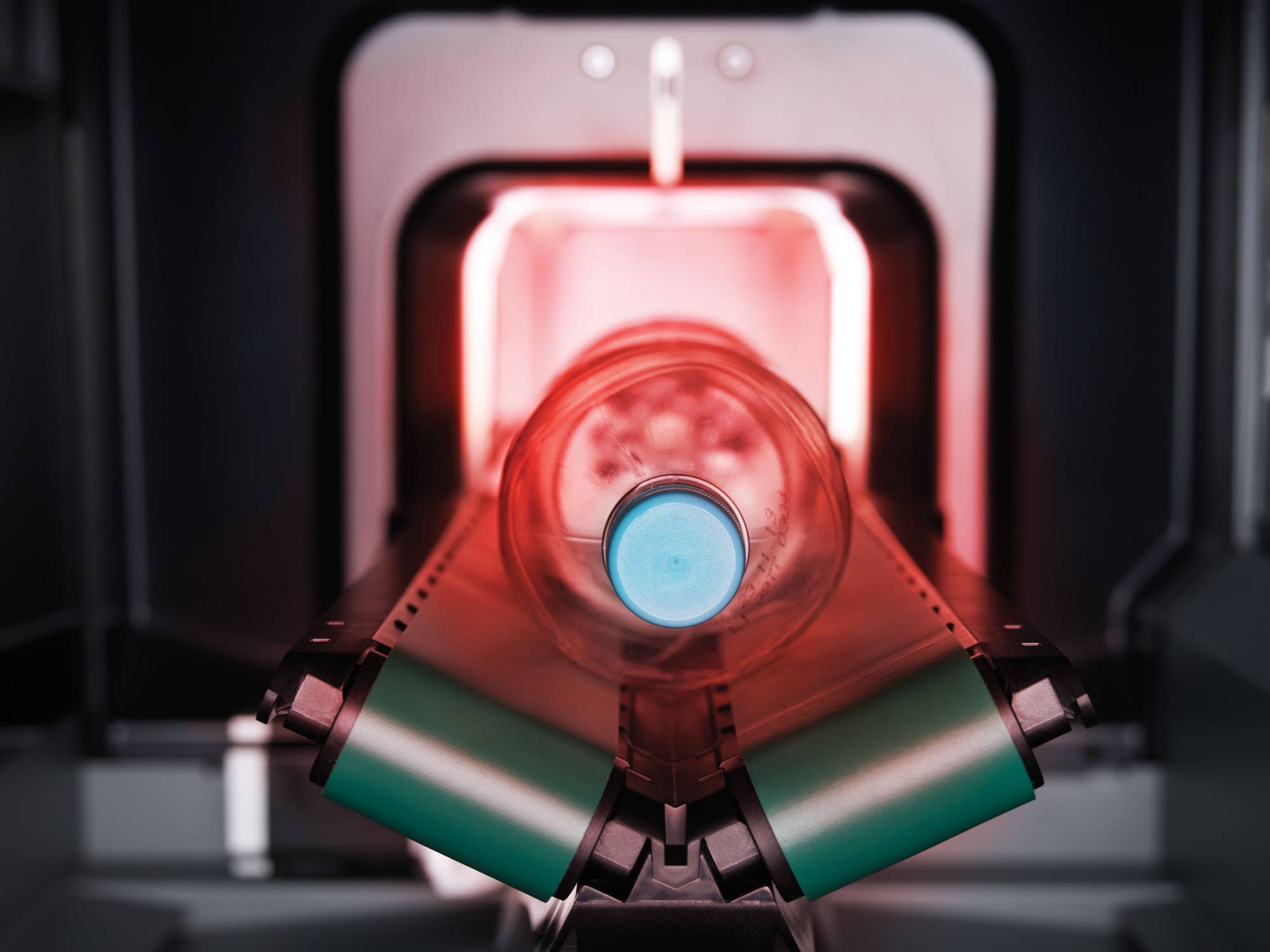
Container compaction provides an important value within deposit systems. By compacting (or crushing) containers with reverse vending machines, PET bottles are reduced in size by a ratio of 2.5 : 1 and aluminum cans 6 : 1. This saves space and therefore transportation costs during material pick-up and mitigates against unauthorized redemption since containers cannot be redeemed twice (known as a “devaluation of containers”). The closer container compaction occurs to the point of redemption, the more fuel, carbon and resources are saved. For this reason, among others, systems like Norway and Sweden promote return to retail and incentivize the use of RVMs that can compact containers.
Retailer participation
- Typically, retailers are paid for their redemption services in the form of a “handling fee”. In high-performing systems this is paid by the beverage-industry-funded Central System Administrator to the retailer on a per-container basis. It is typically set by the CSA. Eight out of the top-10 performing deposit systems pay a handling fee to retailers.6
- With benefits for both the consumer and retailer, consumers may return deposit containers to any retailer in the network, and retailers take back containers similar to the types they sell.
- Retailers below a certain size might not be obligated to participate but can offer redemption services if they wish.
Redemption centers, depots, and/or kiosks
These locations provide deposit container collection alone and can play a role in redeeming containers by:
- Serving high-volume redeemers and consolidating volumes for operational efficiencies.
- Maintaining a minimum number of redemption points per capita (e.g. one redemption point per 366 - 1,100 people).
- Providing redemption locations close to high-consumption points, like outdoor eateries and marketplaces.
- Providing unmanned redemption kiosks at retail locations including parking lots, to provide cost efficiency and convenience.
Why a return-to-retail approach leads to high performance
Not all deposit systems require that retailers take back containers, but there is ample evidence showing return-to-retail deposit systems can achieve the highest performance, convenience and cost efficiency.
Consumer’s perspective
- Convenient redemption options: A 2021 survey in Quebec found that nine out of 10 respondents say they are more likely to participate if they could return their containers where they shop.7
- No extra trips required, and additional travel time eliminated: By positioning container return facilities in locations that people already visit regularly, this removes the barrier of “going out of your way” to recycle. In the US, 97% of shoppers say they shop at a physical grocery store at least once a month.8And despite the growth of digital grocery shopping, grocery pick-up is more popular than delivery, indicating that consumers are seeking convenience and time savings, but not always willing to pay all of the additional convenience fees.9
- Ability to redeem containers while “on the go”: Beverage containers are often consumed on the go, so a high number of redemption points makes redemption more convenient. One US study estimates the percentage of on-the-go consumption between 30-50% of all US beverage container consumption.10And although trends indicate that percentage may be lower post-pandemic with more home-centric habits, there is continued growth in categories like energy drinks and bottled water that are generally consumed on the go.11
- Frequent recycling without waiting is possible: With many supermarkets and grocery stores available, consumers can access multiple return points locally. This reduces waiting or queuing times at the return location, so consumers have the option to take a “little and often” approach to redemption. In user surveys from Norway, over 80% of respondents said having access to a return point without waiting was extremely important in returning their empties.12
Government’s perspective
- Addressing plastics pollution: Beverage container litter as a proportion of all litter is 54% less in regions with a DRS than without, based on Ocean Conservancy’s 2021 International Coastal Cleanup (ICC) data from more than 80 countries and 114 jurisdictions.13And given that the average return rate for return-to-retail deposit systems is 89% vs 77% in systems that do not involve retailers, it is reasonable to infer retailers play a significant role in reducing plastic pollution.14
- Achieving targets: With regions (in particular, EU member states) seeking to achieve ambitious recycling, collection and recycled content targets, deposit return has been recognized as a reliable way to achieve high performance. In 2019, the Government of Ireland commissioned a study to evaluate pathways to meet the EU’s 90% collection target for plastic bottles. The authors stated that “no evidence has been presented to suggest that the current (waste management) system could be enhanced to reliably achieve a 90% separate collection rate. On the basis of this study, a DRS is a feasible option for Ireland, and indeed the only way in which it can confidently be asserted that a 90% collection rate for plastic beverage bottles can be achieved.” The study also recommended return to retail, because such models “generally have higher return rates.”15
- Ensuring convenience: As stated above, since retailers are already located to provide convenient access to purchasing products, they are uniquely positioned to offer convenient return options.
- Immediate results: Governments are currently under pressure to quickly address plastic pollution and rising recycling costs related to the impacts of National Sword. Leveraging existing retail infrastructure in a DRS helps accelerate progress. For example, after Lithuania implemented its return-to-retail-based DRS, beverage container return rates rose from 34% to 92% in less than two years.16
Producer’s perspective
- Hitting targets in a cost-effective way: Off-retail redemption centers tend to incur higher and increasing costs such as labor, site maintenance, profit margin for independent site operators, etc. This is due to the fact that the cost of redemption at off-retail redemption locations reflects 100% of the fixed costs for the location, like insurance, labor, utilities, taxes, etc. In a retail environment, the cost of redemption in the system is reduced because other businesses are sharing those costs and labor. As a result, generally, the system costs are lower when retailers are involved because the redemption network is based on this existing infrastructure and labor that would otherwise need to be paid for in whole.
- Leveraging an existing network: Building on existing logistics networks and infrastructure can form an efficient reverse logistics system. With supermarkets located close to residential areas, the infrastructure for convenient redemption is already in place. A return-to-retail approach reduces the need to permit, build and outfit new recycling locations. As such, the DRS can launch faster, and more cost-effectively. Supermarket chains typically have networks across whole regions, including remote communities, ensuring shopping points are available for everyone. Supermarkets already accommodate trucks for delivery of goods; these could also be used for reversing the logistics or consolidating pick-up and transportation services.
Retailer’s perspective
- Consumers spend deposit refund at retailers: Providing the opportunity to redeem cans and bottles adds another reason for consumers to visit retail locations, and consumers tend to spend their deposit refund money in stores. In a survey of Michigan consumers, 80%17say they spend their deposit refund money at the store where they returned their containers, while assumptions in other markets are as high as 95%.18In another study across four European countries, shoppers returning containers spent up to 50% more money in that store visit than those who did not return empties.
- Many retailers today are also brand owners selling their own private label: In this case they share the “Producer’s perspective” above.
- Positive environmental impact and brand image: Offering convenient access to recycling in store enables retailers to track data on how many containers they help to collect and recycle every year and to tell a brand story about products made from recycled containers, supporting Corporate Social Responsibility commitments. The service also provides a regular reminder to consumers that retailers practice environmental stewardship. For example, in Germany in 2020, the retailer Lidl launched a large advertising campaign promoting how containers returned by customers to more than 6,200 RVMs at Lidl locations are recycled into new bottles, enabling the store’s private label water brand to manufacture new bottles out of 50% recycled content on average.19
System spotlight
Michigan, USA
Since 1990, Michigan's DRS has collected 93% of all deposit containers sold on average.
Norway
Norway offers 15,000 redemption locations, which equates to a ratio of one redemption point per 366 people.
Quebec, Canada
Prior to modernizing its deposit system to include more beverage categories and raise the deposit value, retailers were the only type of return location in the province. To accommodate the increase in redemption volume, policymakers determined that the province needed at least as many return locations as they had at the time in 2022. This was determined to be 1,500 active return locations. Eventually policymakers required the DRS Producer Responsibility Organization (similar to a CSA) to ensure at least 1,200 return locations across the province by the first effective date for expansion (November 2023) and to reach return-rate targets that eventually ratchet up to 90%. The legislation designated a certain number of required return locations per region, depending on their population and density. For example:
- Montreal and Laval (pop. 2.2m): one return point per 15,000 people
- Monteregie, Estrie (pop. 1.9m): one return point per 8,000 people
- Saguenay-Lac-Saint-Jean (pop. 275k): one return point per 6,000 people
- Abitibi-Temiscamingue (pop. 147k): one return point per 4,000 people
The beverage industry Producer Responsibility Organization (PRO) was not expected to operate all of these return locations. They share takeback responsibility with retailers 375 square meters and larger (though retailers can limit redemption to 50 containers per person, per day). The DRS PRO was required to sign contracts with obligated retailers by November 2023 or undergo formal mediation. During this process the beverage industry and retailers worked out a privately negotiated handling fee, which serves as financial compensation from the beverage industry to the retailers taking back used beverage containers. Several retailers may collectively finance and operate a “Return Center” nearby instead of taking back containers in store, as long as they gain approval from the PRO. The PRO may open and operate “bulk return points” (e.g. a “depot” or “redemption center”). Opening bulk return points comes at the expense of the beverage industry-run PRO. However, the industry is incentivized to open such return locations due to a) the need to meet the 90% return-rate target, b) assisting their retail customers in balancing redemption volume, and c) an interest in reducing container pick-up costs by consolidating volumes of returns at a relatively few number of locations rather than province wide. As of August 2025, 300 such Bulk Return Points are planned. Depots, retailers, and Return Centers all count towards the 1,200 minimum number of return locations required, as long as they meet minimum criteria for site opening hours, safety, and accessibility.
California, USA
California is a perfect example of the impact of inconvenience on recycling performance. California’s deposit system was built on the backbone of a network of redemption centers, with no redemption obligations for retailers. Retailers are only obligated to redeem containers if they are not located near redemption centers (or if redemption centers close, as is now the case in many instances). Until 2025, retailers were allowed to opt out of redemption by paying a fee of US$100 (€86) per day, but this was largely unenforced.
Redemption centers (known as “recycling centers” in California) have been hobbled by a rigid and outdated state funding formula that leaves the centers with insufficient revenue while commodity prices plunge and operating costs such as the minimum wage rise.
As a result, redemption centers have closed en masse since 2013. Closures have left California with 1,286 recycling centers, less than half the 2,578 centers that were in operation in 2012. centers that were in operation in 2012.
________________________
2 Compares return to retail only markets with systems that do not rely on retailer redemption at all (return to redemption center or return to depot). Includes “mature” DRS programs only, or those >2 years old. Calculated based on “Global Deposit Book 2024,” Reloop. 2025 and Global Deposit Dashboard latest rates.
3 “American Bottles: The Road to No Return,” Friedel, R. Environmental History. 2014.
4 Unless otherwise noted, all data from Reloop Global Deposit Dashboard accessed November 4, 2025 via: https://www.reloopplatform.org/global-deposit-dashboard/.
5 “California return rate: "Bottle Bill Resource Guide," Container Recycling Institute. Accessed November 4, 2025. Redemption Locations: "2024 Beverage Container Recycling in California," CalRecycle. 2025.
6 “Global Deposit Book 2024,” Reloop. 2025 and Global Deposit Dashboard latest rates.
7 "Consumer participation in deposit return systems: drivers, barriers, and implications,” Reloop. 2023.
8 “In-Person Grocery Shopping Rebounds in U.S.; Online Also Up,” Gallup. 2022.
9 Coresight Research, "Online Grocery Survey 2022," March 2022.
10 “Container Recycling Institute Releases Special 2013 Vermont Bottle Bill Report,” Container Recycling Institute and Vermont Public Interest Research Group. 2013.
11 “2024 Beverage Trends: Insights into Winners and Losers,” Cascadia Managing Brands. January 2025.
12 “Profiling Shoppers in Norway, Finland and Holland,” TNS Gallup. 2003. Refers to 1,356 Norwegian retail deposit and non-deposit system user interviews.
13 “Littered with evidence: Proof that deposit return systems work,” Reloop. 2025.
14 “Global Deposit Book 2024,” Reloop. 2025.
15 “Improving the Capture Rate of Single-Use Beverage Containers in Ireland,” Eunomia. 2019. Commissioned by the Government of Ireland, Department of Environment, Climate and Communications. Accessed via: https://assets.gov.ie/89537/e5054d08-b398-4346-a69b-8f31839c19cd.pdf.
16 "Lithuania exceeds container return rate expectations as TOMRA supports new state of the art deposit systems,” TOMRA.com. June 2018.
17 “TOMRA Recycling Machine Compliance Research,” Dig Insights. 2022. Survey of 500 Michigan deposit system users. The survey allowed respondents to select all answers that applied.
18 “Profiling Shoppers in Norway, Finland and Holland,” TNS Gallup. 2003. Sample: 8,500 deposit users.
19 "100 percent recycled PET in a beverage bottle: Lidl uses only recyclate for a 1.5-liter "Saskia still" water bottle," Petnology.com. 2019.
20 “Bottle Deposit Information,” Michigan.gov.
21 “MRG Michigan Poll - Spring 2019,” Marketing Resource Group. May 2019.
22 "Infinitum Annual Report 2024," Infinitum. 2025.
23 "Infinitum Annual Report 2024," Infinitum. 2025.
24 “California’s Beverage Container Recycling and Litter Reduction Program Fact Sheet,” California Environmental Protection Agency. 2013. 2024: “Global Deposit Book 2024,” Reloop. 2025.
25 Consumer Watchdog. 2020.
26 “California,” BottleBill.org. 2025.
Download the "Rewarding Recycling" white paper