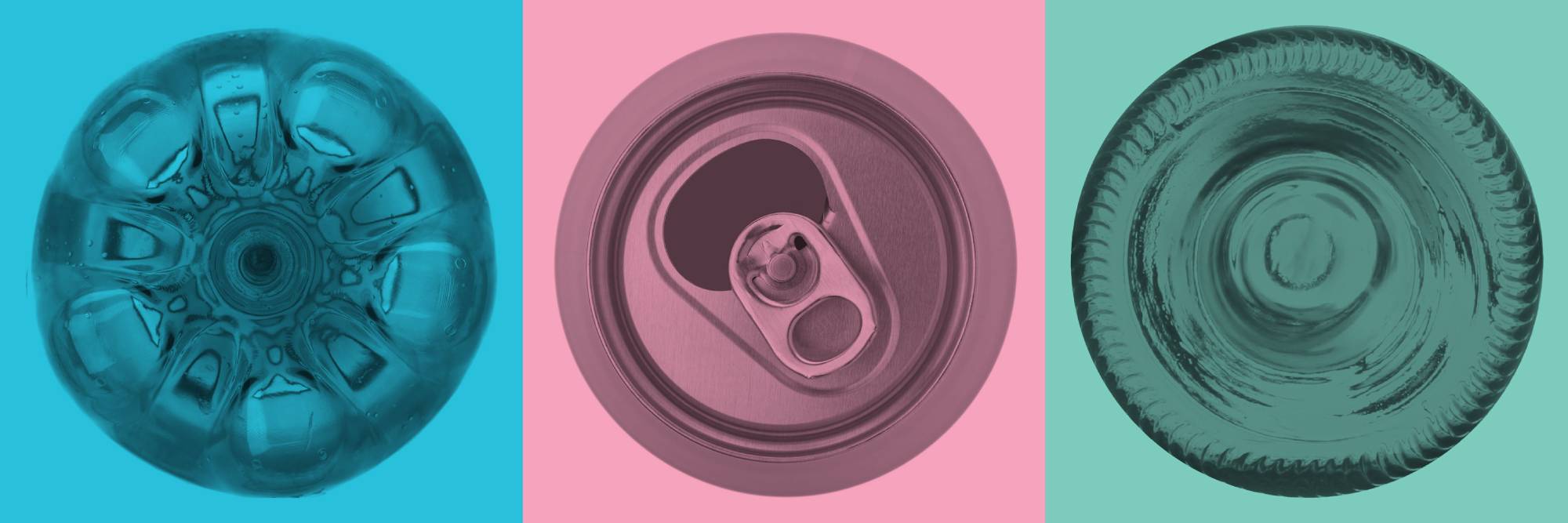
Effective deposit return systems accommodate the drinks sold on the market today. This means considering beverage type, size and material the container is made of. The material included in a deposit system – such as plastic, metal, glass and liquid paperboard – is defined by legislation. Typically, policymakers focus on the beverage packaging commonly used by producers, as well as considering the recyclability of container materials.
What types of materials are included in deposit return schemes?
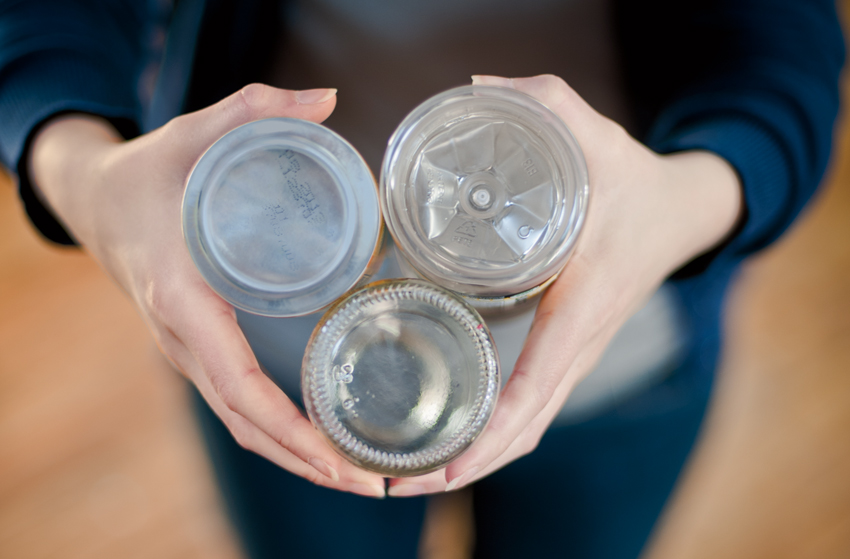
The most common types of materials found in deposit return systems are plastic, cans (aluminum and steel), and glass. Several programs also include liquid paperboard (cartons) and reusable containers.
Even leaving out one type could mean millions of recyclable containers are wasted and potentially littered. A broad scope of accepted materials reduces consumer confusion about eligible containers, so it encourages more DRS participation from the public and means more recyclable materials become part of the Clean Loop Recycling system.
Considerations for drink containers in DRS
- Ease of recyclability: An effective DRS should include as many material types as possible, as most drink container materials are highly recyclable, representing a low threshold for recycling efforts.
- Level playing field: Including all container types creates a fair playing field among beverage producers. Otherwise, it risks consumers switching to container types left out of the DRS, to avoid perceived price rises.
- Corporate social responsibility: Sustainability is high on the public agenda and consumers are paying more attention than ever to businesses' green credentials. DRS participation contributes to recycled-content goals and green commitments.
- Potential of the technology: Today’s reverse vending technology can handle all types of drink containers. This opens new possibilities for what can be collected — even new material types in future recycling systems.
Broad scope of beverages and beverage containers
Incentivizing beverage container returns
The importance of separate collection
Plastic material in deposit return schemes
Recyclability of plastic
Plastic beverage bottles are typically made of PET (Polyethylene Terephthalate) or HDPE (High-Density Polyethylene). Produced from petroleum, a type of fossil fuel, it takes a quarter of a liter of oil to produce a single one-liter water bottle from virgin plastic.⁴ And, when over a million plastic bottles are sold every minute⁵, the total volume of oil is vast. However, PET and HDPE are highly recyclable materials, and resources that can be reused again and again to produce new beverage containers. Unfortunately, scientists have determined that of all the plastic ever produced, only 9% has been recycled.⁶
What happens to your plastic container when you recycle it?
After plastic containers are returned for recycling, they are collected and sent to a sorting facility. They are then sorted by material type and color. A recycling plant next cleans the containers to remove any contaminants (like labels and glues) or food residue. It shreds or crushes bottles into small flakes, which may be melted into pellets. These are then sent to manufacturers to be re-melted and injected into preformed molds, to shape them back into new bottles. These new drink containers are then filled with the next beverage and distributed to stores, where they are purchased, consumed and returned – then the cycle repeats.
The plastic pollution problem
Glass material in deposit return schemes
Recyclability of glass
Glass bottles and jars are 100% recyclable and can be recycled endlessly without any loss in purity or quality. This type of glass has a 1:1 recycling ratio, meaning that when one glass bottle is recycled, a full glass bottle can be produced from it, generally in less than 30 days.¹¹ 38 of the 45 deposit systems in place today include glass bottles, and 12 of those include one-way/non-reusable glass. Glass drink containers in a DRS can achieve high collection rates, with the glass bottle redemption rate across Canada’s deposit systems averaging 77.7%, with one region (Saskatchewan) achieving a 94% return rate.¹²
Glass production
New glass is produced from sand, soda ash, limestone and other additives for color. While there are no shortages of these materials, extraction and processing consumes natural resources and energy. Recycling glass saves energy and is more economical. • Permanent material: Glass can be used infinitely, making it especially important to be collected and enter the Clean Loop, where its high quality can be preserved and the material reused. If left in landfill, it would take 4,000 to 1 million years to break down.¹³ • Energy savings: Recycling glass uses only 30% of the energy needed to make new glass from raw materials, as crushed recycled glass melts at a lower temperature, extending equipment life. Using 10% recycled glass (cullet) in new glass production reduces CO2 emissions by around 5%.¹⁴ • Reduced cost: 1 kilogram of recycled glass is the equivalent of 1.2 kilograms in raw materials, and can replace up to 95% of the materials needed for production. This causes a cost reduction which, when combined with energy savings, provides a stabilizing effect on the cost of creating glass containers.
Separating glass from other household recycling or waste
DRSs achieve the highest recycling rates, due to no contamination from other materials. Glass poses a particular challenge in roadside recycling as it can break and contaminate other materials, reducing its own value at the same time. Separating glass from other recyclable materials through a deposit system ensures 100% of that glass can be reused – by contrast, a survey of 45 material recovery facilities accepting curbside glass found almost 40% of their glass ended up in a landfill.¹⁵
What happens to your glass container when you recycle it?
When recycling companies collect glass containers, their first step is to remove non-glass items using magnets and air suction – this keeps the glass purity and quality high. Lasers separate the glass by color, and it is then crushed into small pieces. The cullet is melted in a furnace at 1500 degrees Celsius, and key ingredients are added before the liquid glass is divided into globs. These globs are blown or moulded into new bottles and jars which can then be filled, used and recycled back into the loop.¹⁶
Cans material in deposit return schemes
Recyclability of cans
Metal is another "permanent" drink container material that can be reused endlessly, so it is important to keep these materials pure and of high quality, to remain in the loop. Recycled cans, made of aluminum or steel, can be made into new beverage cans in as little as 60 days. Using recycled cans to make new containers saves on average 95% of the energy required to smelt raw bauxite ore. Recycling one can can save enough energy to run a television for three hours. Also, the high value of scrap aluminum means including this material in a DRS can help fund the system through commodity sales.¹⁷
What happens to your can when you recycle it?
Cans are taken to a recycling centre where they are combined with other cans to be shaped into a large bale, ready to take to specialist aluminum recyclers. The bale is shredded into smaller pieces, which are heated into molten aluminum. These are formed into a pure block of metal (“ingot”) for easy transportation and further processing. It is this material that is used to form new cans.
Spotlight: The Netherlands
The glass, metal and plastic PET container industries agree that deposit systems lead to higher recycling rates, as well as better quality, higher value material enabling circularity. We support efficient, effective deposit systems. Deposits produce a resilient supply of material that our industries need to make new beverage containers.
Liquid paperboard material in deposit return schemes
Recyclability of LPB
Liquid paperboard (LPB) is the packaging material generally used for flavored milk, juice boxes and cartons. Because this packaging is so lightweight, it requires less energy to transport and refrigerate than other beverage packaging. It is made from cardboard, plastic and, in some cases, a thin layer of aluminum foil. Paperboard makes up the largest proportion of these materials, about 88% of a 1-liter carton of milk. Liquid paperboard is currently included in the DRSs in many Canadian provinces and several states in Australia. There is a growing trend in integrating LPB in upcoming new DRSs. Tetra Pak, the world's largest producer of LPB, has expressed in several markets a desire to be included in the DRS.
It is essential to seize the moment by implementing an ambitious DRS, that includes a wide range of packaging materials. Limiting the scope of the scheme would be a missed opportunity, particularly if low carbon, renewable packaging formats, such as carton packages, are excluded. If cartons were to be included in the DRS, it would increase the volume of good quality, recycled paperboard available to the industry, allowing further investment to be made in carton recycling infrastructure.
What happens to LPB when you recycle it?
When cartons are collected, they are sorted and separated into paper/cardboard streams. The materials are baled together and sent to paper mills, where the bales are shredded and blended with water to break down the materials. This mix is screened and separated into paper pulp, plastic and aluminum layers, before going through de-inking to remove dyes or colors used on the products. The paper pulp is then ready to be processed and turned into new paper products like paper towels, tissue and paper bags.²²
Upcoming beverage container materials and types
The effectiveness of high-performing deposit return systems is seeing growing interest in other container materials and beverage types.
Reusable beverage containers
Reusable containers are cleaned and used again, without melting and re-forming, so require less processing and are therefore better for the environment. Reusable systems were common in the early 1900s²³, and DRSs can facilitate a transition to reusable containers by prompting consumers to return containers and building the collection infrastructure to make reuse possible. Oregon’s refillable beer program started in part because the infrastructure and cost-sharing between producers was already in place through a non-reusable DRS. Germany leads the way with one of the world’s most successful reusable beverage schemes – with a 41% reuse quota, collecting 98% of reusable containers annually (25.4 billion fillings), as well as 98% of one-way containers (20.5 billion containers).²⁴
Coffee cups
Around 500 billion coffee cups are produced worldwide each year. Disposable coffee cups are lined with plastic that is tightly bonded to the paper. This prevents leaks, but means they cannot be recycled at standard paper recycling plants. TOMRA has demonstrated the ability of reverse vending technology to take coffee cups, so adding cups to the list of drink containers a DRS can handle is not far away. TOMRA Reuse has pilots for reusable coffee cups.