Rich Text Block The Circular Economy as Economic Reality
The circular economy is more than an environmental ideal — it is rapidly becoming an economic and regulatory reality. Across the world, governments are tightening extended producer responsibility (EPR) rules, mandating recycled content in packaging, and establishing deposit return schemes. For businesses, the ability to recover and reuse materials is no longer optional: it is a strategic imperative.
At the heart of this transition is technology. Without precision sorting, the circular economy simply cannot function at scale. Mixed waste streams produce low-quality materials that are expensive to process and hard to sell. High-purity material streams, by contrast, command premium prices and can genuinely replace virgin materials in new products.
Rich Text Block Near-Infrared: Seeing What the Eye Cannot
The workhorse of modern sorting is near-infrared (NIR) spectroscopy. NIR sensors fire a beam of infrared light at material on a fast-moving conveyor belt and analyse the reflected spectrum. Because different materials — PET, HDPE, PP, paper, cardboard, glass — each have a unique NIR fingerprint, the sensor can identify and classify them in milliseconds.
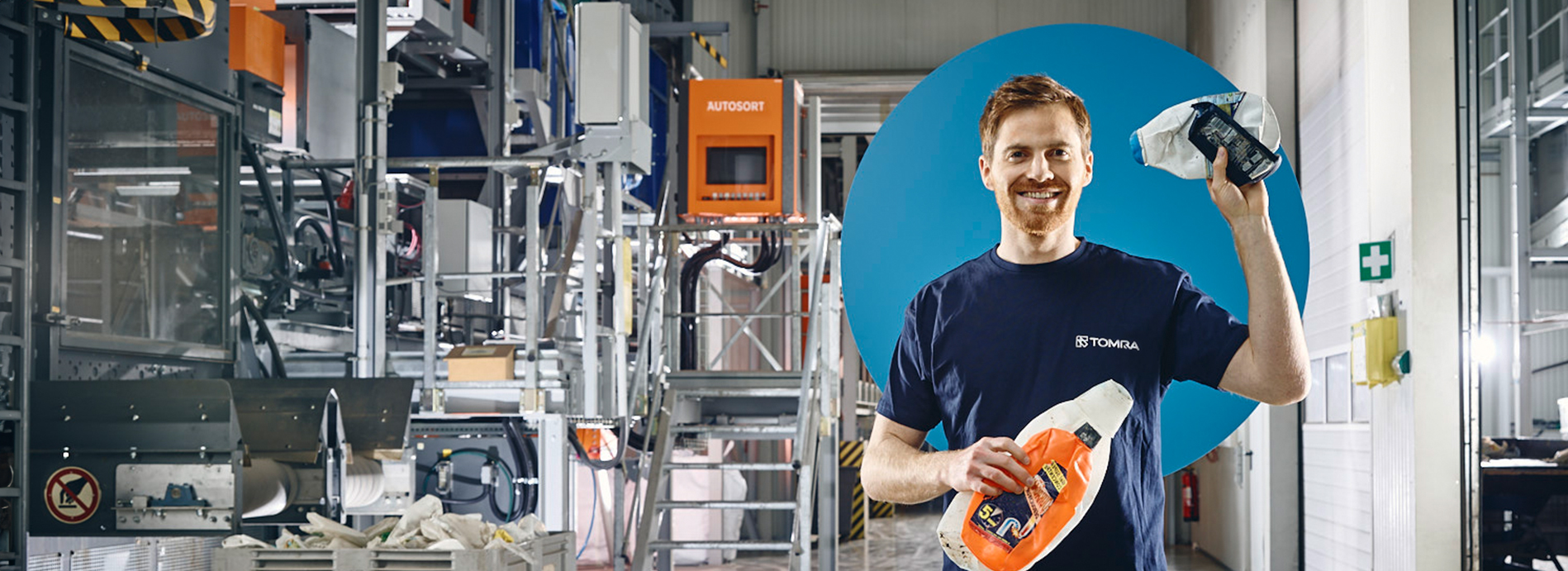
TOMRA's AUTOSORT platform uses this technology alongside advanced algorithms to sort mixed post-consumer waste with accuracy levels that were unthinkable a decade ago. A single AUTOSORT line can process up to 35 tonnes of material per hour — picking out target fractions with purity rates above 95%.
AI and Machine Learning in the Sortation Hall
NIR is now being complemented by artificial intelligence. TOMRA's GAIN intelligence platform collects real-time data from sensors across a sorting plant, builds a digital picture of the incoming material stream, and continuously adjusts the sorting parameters to maintain optimal performance — even as the composition of the waste changes seasonally or by geography.
Sorting technology has crossed a threshold. We are now achieving purity and recovery levels that make recycled polymers genuinely competitive with virgin plastic on both price and quality. The circular economy is no longer aspirational — it is operational.
Quote Block Dr. Anna MüllerHead of Sensor Technology, TOMRA Recycling

Rich Text Block From Food to Packaging: The Breadth of Sensor Sorting
The same optical sensing principles that sort plastic bottles are equally powerful in food processing. TOMRA Food's sorting machines use cameras, NIR, laser and X-ray technology to detect defects, foreign objects and quality deviations in nuts, grains, vegetables, poultry and seafood — all at line speeds that would be impossible to replicate manually.
In the potato industry alone, TOMRA's machines reduce giveaway by billions of kilograms annually. In nut processing, laser-based sorters detect aflatoxin contamination that is invisible to the naked eye. In seafood, X-ray technology finds bone fragments that would otherwise trigger costly recalls.
Accordion Block TOMRA Sensing Technologies Explained
Discover More Block Keep Exploring
More from TOMRA on sensor sorting, circular economy and resource productivity
CTA Block See TOMRA Sorting in Action